The TEA-ROOM + METACITY
Artificial Moons
A community does not emerge from architecture and institutions alone. People call it by a shared name, raise its symbols, tell its stories, and return to its festivals. Even when their beginnings are contingent, acts that are repeated and shared eventually acquire the force of cultural reality.
Makuhari New City was developed from the 1970s onwards as a planned city on reclaimed land along Tokyo Bay. Unlike cities in which history and tradition have accumulated over long periods, it had no shared symbols or narratives capable of binding the place into a community. The project described this condition as a “cultural desert”.
Administratively, Makuhari New City is part of Chiba City; no municipality called “Makuhari City” exists. Nevertheless, media reports and everyday conversations have often referred to it as though it did. METACITY’s Multi-Layered City “Makuhari City” did not correct this misrecognition, but embraced it as a fiction that had already entered reality. Rather than constructing a non-existent city through buildings and infrastructure, the project sought to bring it into being through the invisible mechanisms by which a city acquires culture: a name, an emblem, festivals, stories, and processes of collective decision-making. It was an attempt to transform a “cultural desert” into a “cultural forest”.
《Artificial Moons》 was the first work of public art installed in this “Makuhari City”, a monument announcing the cultural beginning of a new city. Its fictional civic emblem depicts nine moons, drawing on the syllable ku in Ma-ku-hari and ku as one Japanese reading of the number nine.
This play between language and number is not a joke permitted only to a fictional city. Fukuoka’s official emblem combines nine instances of the katakana character fu to evoke fuku—fu joined with ku, a reading of nine—the first part of Fukuoka and the Japanese word for good fortune. Kurume’s emblem similarly arranges nine katakana ru around the character 米, read me in the city’s name: nine, or ku, with ru and me yields Ku-ru-me. The symbols of real cities do not necessarily arise from historical inevitability. Repeatedly displayed and encountered, they gradually acquire reality as the faces of their cities.
Festivals likewise continue even after certainty about their origins or original meanings has faded. Bodily movement, sound, procession, and gesture are repeated across generations, continually producing a community’s shared sense of time. What makes culture real is not a verifiable origin, but the fact that it continues to operate as movement in the present.
The work brings this cultural movement into resonance with the motion of nine celestial bodies. The nine moons do not exist in the physical sky. Within a virtual space, they exert gravitational force upon one another, tracing unpredictable trajectories through a real-time N-body simulation. Initial conditions set by human hands develop, through the moons’ interactions, into movements that depart from the intentions of their designer.
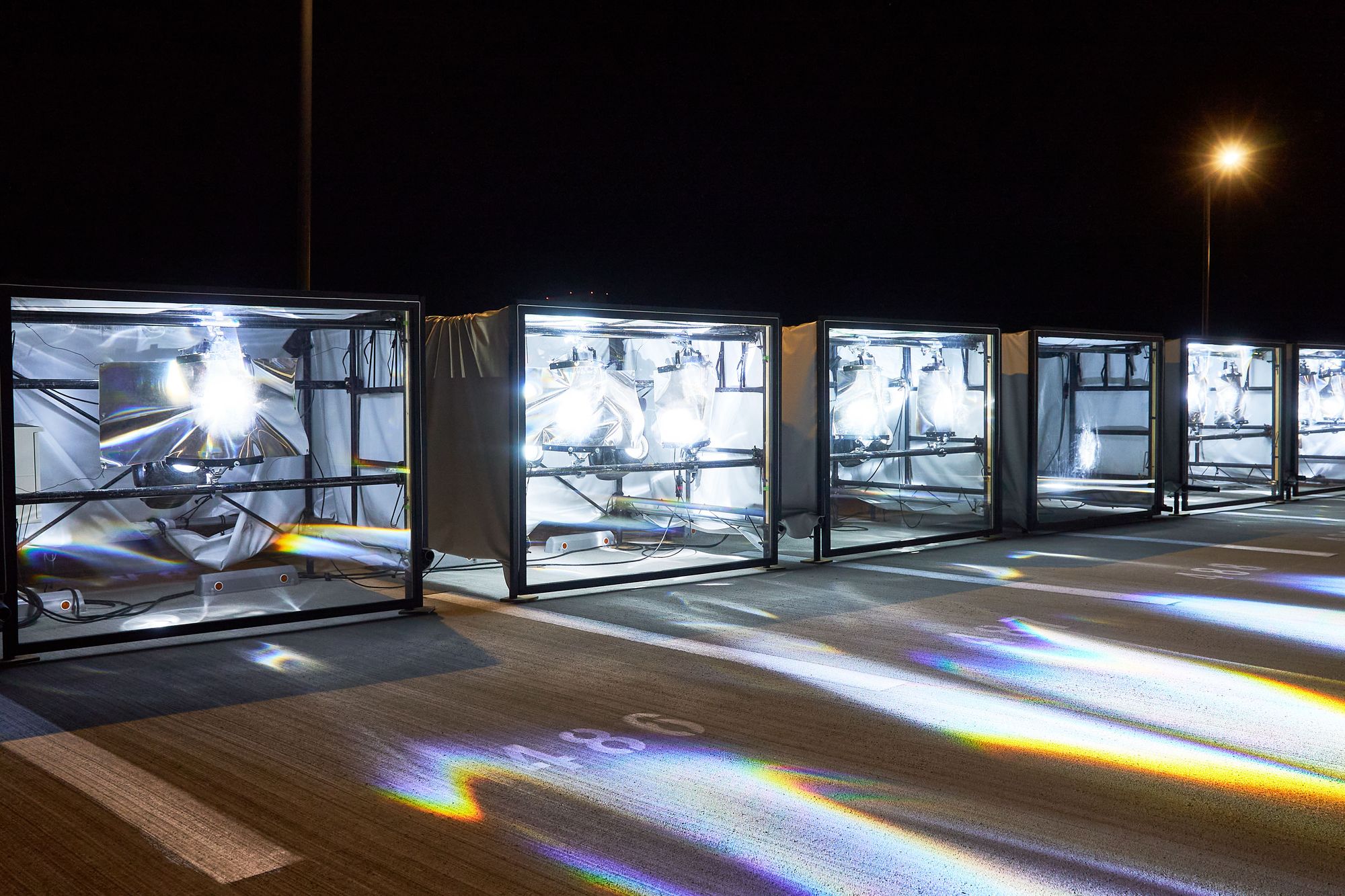
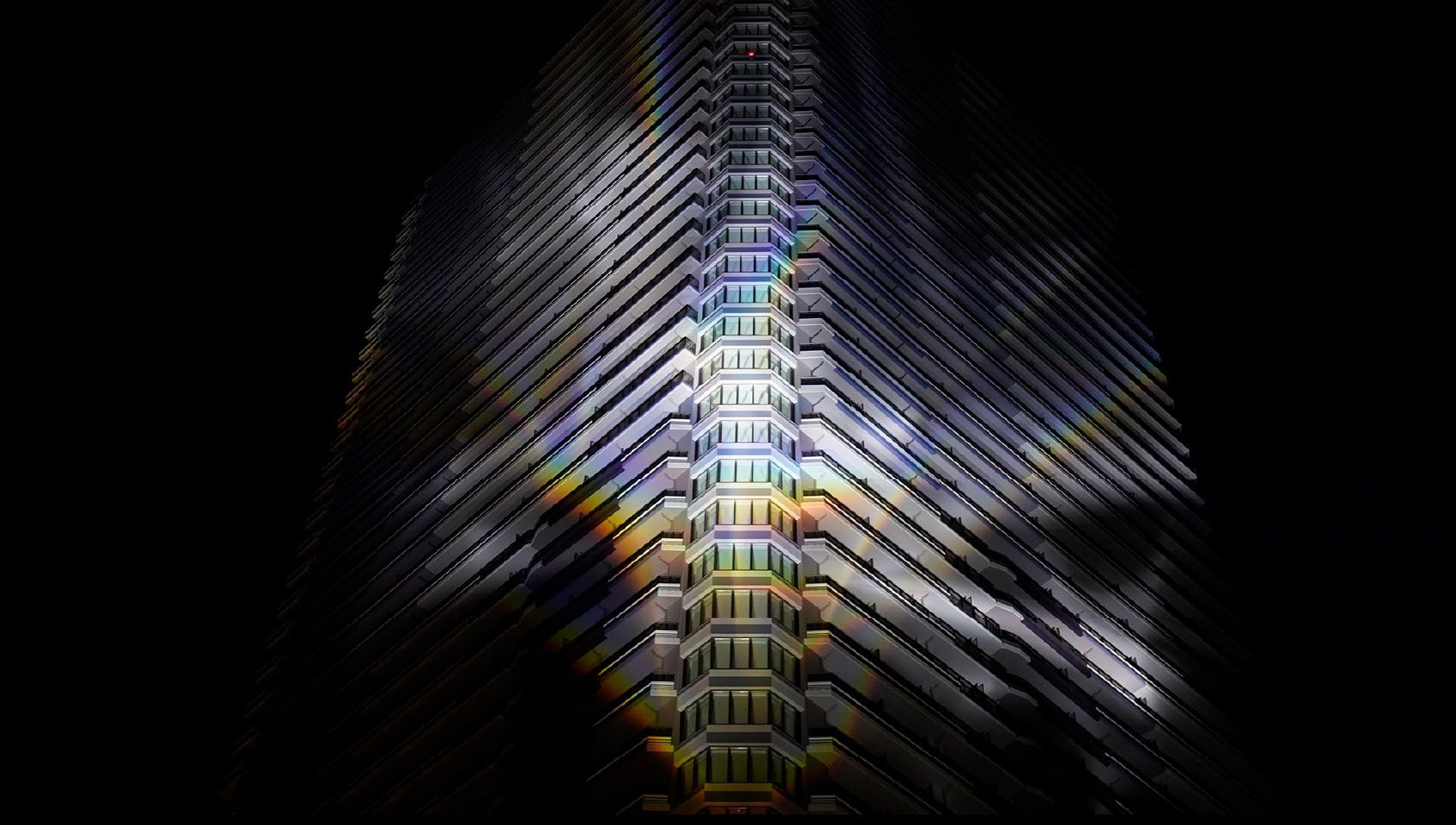
Data from their motion drives sixteen high-output moving-head lights illuminating a 150-metre building in Makuhari New City. Before reaching the building, the light is reflected, removing the directness of its source and naturalising artificial illumination into something perceived like a natural phenomenon. Slightly out of alignment, the multiple lights move as a swarm, producing fluctuations across the building’s surface that no single source could create.
Here, simulation is used not to predict the future, but to introduce unpredictability into a planned city. It brings contingency and time into an artificially initiated world, giving it a vitality that cannot be fully controlled by its founders.
Across East Asia, cultures have long read time and season through the phases of the moon, sharing time with others through poetry, ritual, and the act of looking upwards together. In the Japanese archipelago, connections have also been proposed between Jōmon-period sites and lunar movements. The moon has long shaped ways of reckoning time, performing ritual, and imagining the world.
The work transposes this relationship with the moon into a fictional city through nine artificial moons. By acquiring moons of its own, the city gains its own time, narratives, and imagination. If the sun is the source of life, the moon is the source of culture.
For approximately six weeks, artificial moonlight returned to the city night after night and could be seen from more than a kilometre away. The non-existent “Makuhari City” acquired its own sky and celestial bodies, while the act of looking up at their light became a festival for the new city. After the physical installation ended, the nine moons continue, within the work’s fictional world, to orbit through the information space of “Makuhari City”.
The work does not represent a fictional city; it establishes the conditions through which one can begin to operate. A civic emblem born from wordplay, celestial bodies that move beyond their designer’s intentions, recurring light, science-fiction narratives, and shared memories converge to give a non-existent city cultural reality. Fiction does not stand in opposition to reality. It is also a mechanism through which a world that does not yet exist can become shareable—and begin to act upon the real.