
The TEA-ROOM
Hello, Error!
In the age of deepfakes, the question is not simply whether an image is real or false. Why do we trust one face, voice or professional title, while doubting another?
Hello, Error! refers to the nijiriguchi, the small entrance to a tea room, as an architectural technology. In an era when social hierarchies held considerable force, the nijiriguchi functioned both as a boundary separating the secular world from the tea room and as a device that temporarily stripped those who passed through it of their social status. No matter how high their rank, guests had to crouch and lower their heads to enter. It did not abolish the hierarchies of the outside world, but suspended their force within the tea room, reconstituting those present through a different relationship: host and guest. Rather than explaining an idea through words, the nijiriguchi used architecture and the body to alter perception and social relations.
Human perception is shaped by cognitive biases such as the halo effect, in which an impression formed from one characteristic influences how a person and their words are judged as a whole. Face, voice, age, gender and professional title can establish the credibility and authority of a statement before its meaning is considered. Such cognitive mechanisms are, in a sense, already installed within us, allowing us to make rapid judgements in a complex world. They cannot simply be classified as good or bad. Yet when they operate without our awareness, they can repeat and reinforce existing relations of power and prejudice.
Deepfakes have not created a new error within human perception. By artificially altering faces and voices, they exploit the ways in which we already assign trust, authority and intimacy. The problem lies not only in the falsity of an image, but in the cognitive mechanisms that lead us to believe it.
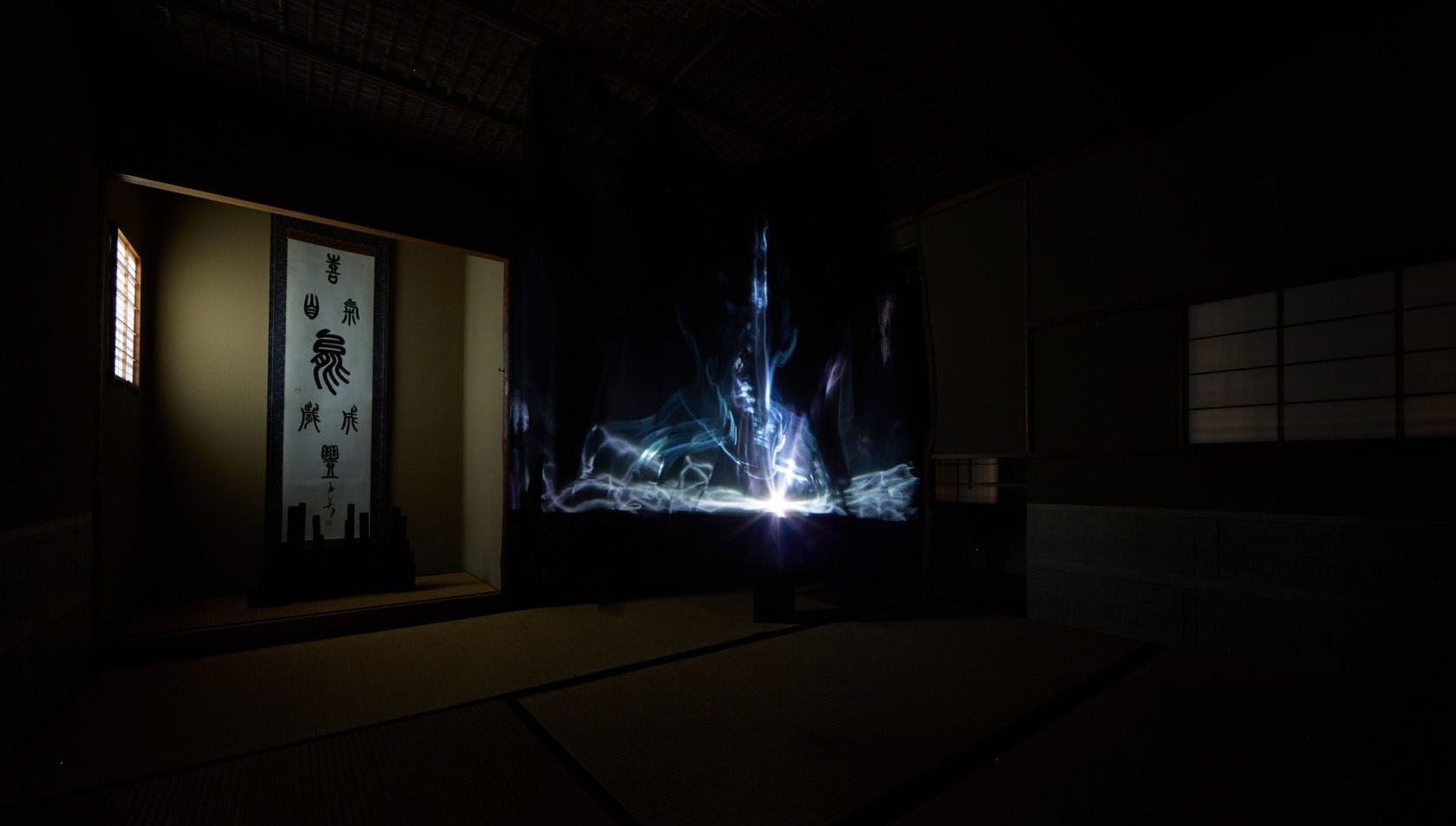
In Hello, Error!, several people of different professional titles, ages and genders first state these attributes, then deliver the same explanation of the nijiriguchi. Viewers sit at the entrance or peer through its narrow opening, experiencing how differently the same account can be received depending on who is understood to be speaking.
Only the outlines of the speakers are projected onto multiple layers of suspended organdie. As fans set the fabric in motion, their contours waver and their bodies appear to hover in mid-air, losing their physical solidity. Lower frequencies—treated within the work as acoustic cues capable of producing trust and authority—are removed from their voices. While physical information about the speakers is stripped away, their professional titles, ages and genders are explicitly presented through language.
Through this contradiction, the work does not attempt to create perception without bias. Instead, it allows viewers to experience the moment at which the halo effect begins to operate within them. Even as the speaker’s image dissolves and the voice loses its depth, the social information already provided continues to shape how that person is perceived.
Just as the historical nijiriguchi used architecture and the body to suspend the force of social status, Hello, Error! brings image, sound and the viewer’s body together to create a space in which we can become conscious of the cognitive mechanisms installed within us. It asks us to encounter error again—not as something that can simply be eliminated, but as part of how we see the world. Hello, Error!