
METACITY
New Rousseau Machine
Democracy is a form of calculation. We express our individual preferences through ballots; they are counted and transformed into a single collective decision. But does the collective will exist before the count, or is it produced by the way the votes are counted?
From a classroom choosing a group activity to a community deciding how to use shared spaces or resources, a municipality allocating its budget, or a nation electing its representatives, majority voting is treated as an almost self-evident method of collective decision-making. Yet majority voting is not democracy itself. It is only one of several technologies for transforming multiple preferences into a single result.
Every aggregation rule has its own characteristics and structural weaknesses. Simple plurality—the option receiving the most votes—is easy to understand, but discards preferences beyond each voter’s first choice and is vulnerable to vote splitting. The Borda count incorporates ranked preferences but can be affected by strategic ranking. Representative democracy delegates judgement to elected representatives, while liquid democracy allows that delegation to change according to the issue; both can produce concentrations of power and complex chains of delegation. No universal, neutral aggregation rule can represent every dimension of the collective will without distortion.
This problem precedes agitation, manipulation, or electoral fraud. Even when every participant votes of their own accord and every ballot is counted accurately, changing the aggregation rule can change the result. Once accepted as the will of a group through a legitimate procedure, however, that decision functions as a social contract that binds its members and cannot easily be reversed.
In 1762, Jean-Jacques Rousseau introduced the concept of the general will in The Social Contract as the basis of a political community. Yet the general will cannot be directly observed or extracted in an unmediated form. Transforming the preferences of many individuals into a single decision always requires some form of calculation. New Rousseau Machine focuses on how that calculation does not merely measure the collective will, but produces it in a particular form.
The work is both a voting and aggregation system developed by METACITY for the fictional administrative district Multi-layered City “Makuhari City”, and an installation that gives this system material form. Rather than beginning by imagining the physical form of a city, the project began by designing its operating system: the process through which a city forms its collective decisions.
The voting experiment presented three questions concerning the city’s fundamental direction, demographic composition, and allocation of its budget, each with three possible options. The resulting twenty-seven world-lines were calculated through four aggregation rules: direct voting by simple plurality, the Borda count, representative democracy, and liquid democracy. Although the same voting data were used and each result was calculated correctly according to its prescribed rule, the four rules selected different world-lines.
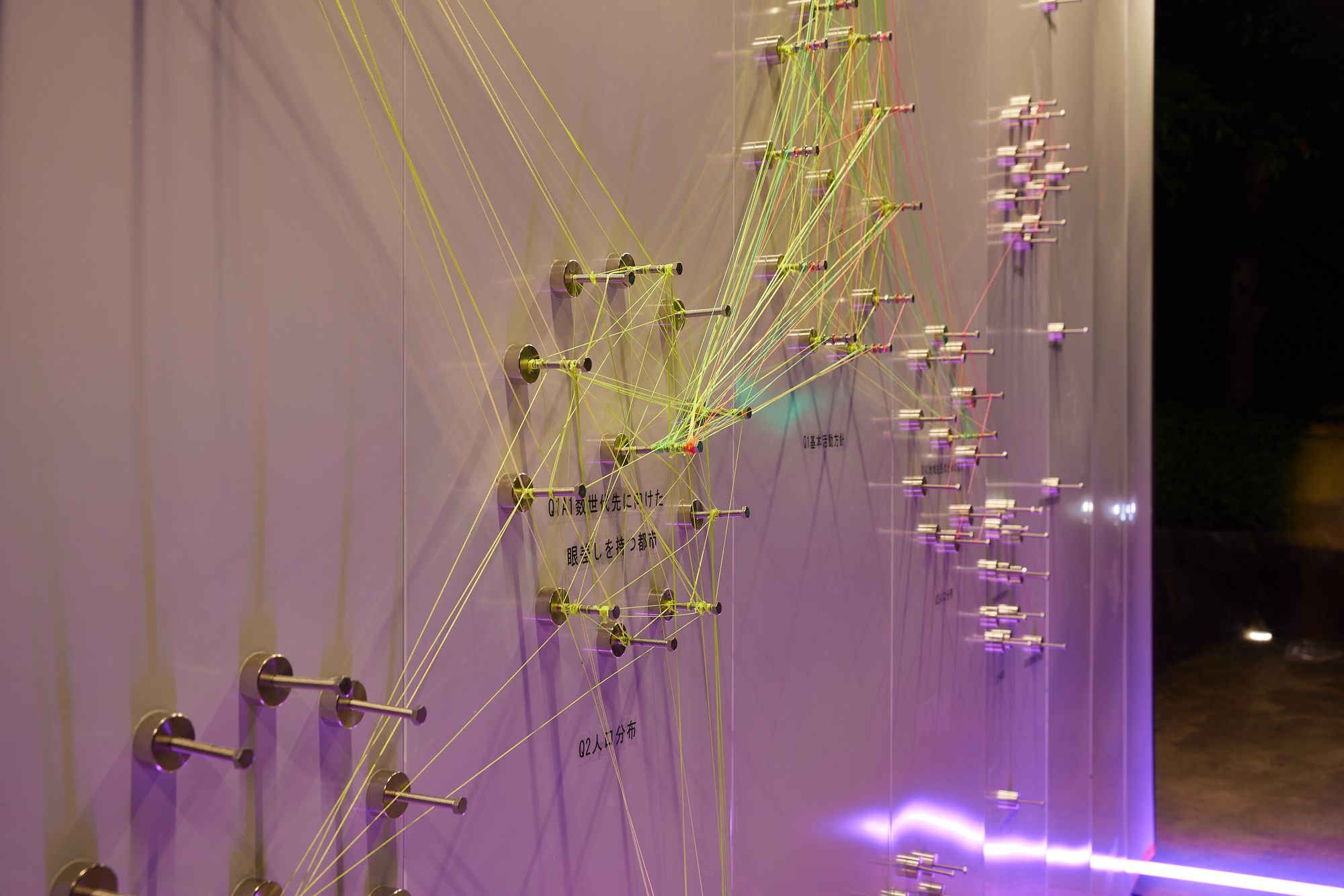
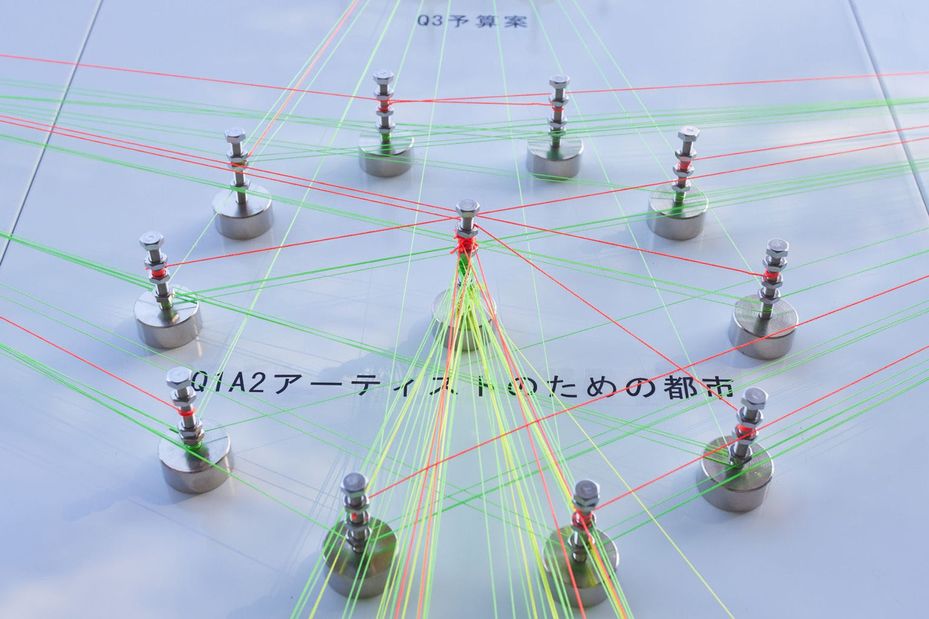
These branching world-lines are constructed using materials associated with public works and temporary construction sites: a temporary wall, screws, construction strings, temporary barriers, and label tape. The screws indicate voters and options, while differently coloured strings trace how votes and delegations travel through each aggregation rule. An otherwise invisible process of aggregation becomes a physical network extending across the wall. By using the materials of public works, the installation connects the calculation that produces the collective will with the process through which that calculation makes one direction for the city real.
New Rousseau Machine does not propose replacing majority voting with another, supposedly correct method. The problem is not only that no perfect aggregation rule exists. It is also that we have become largely unaware of the technologies through which collective decisions are made, accepting their outputs as the self-evident will of the people.
The collective will is not discovered as a single answer that already exists. It is given a particular form by the aggregation technology through which it is calculated.