The TEA-ROOM
VOID SYSTEM
Before it is a building, a tea room is a system for shifting the mode of perception. Stillness is not inherently present within it. It is produced through relationships among boundaries, gestures, materials, and sound.
Within chanoyu, the Japanese practice of tea, there is an idea known as shichū no sankyo—“a mountain retreat within the city”. Though remaining in the midst of the city, one enters the stillness of a remote mountain hermitage. The guest proceeds through the roji, the garden approach, lowers the body through the nijiriguchi, the small crawl-through entrance, and enters a confined interior. The architecture and sequence of gestures do not physically remove the city. They bring a different perceptual world into being within the same place.
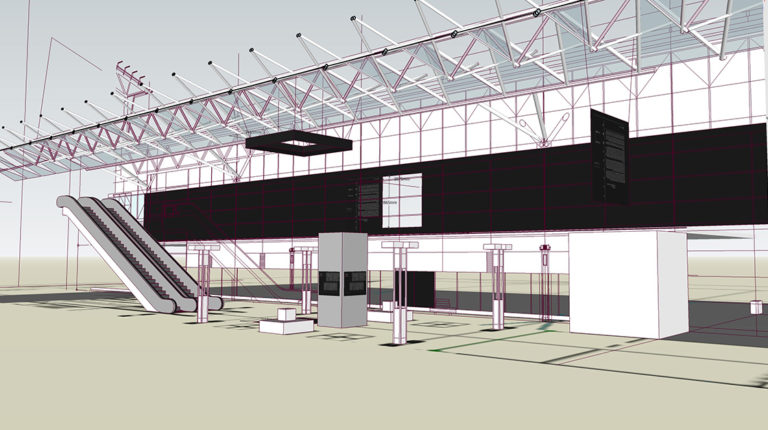
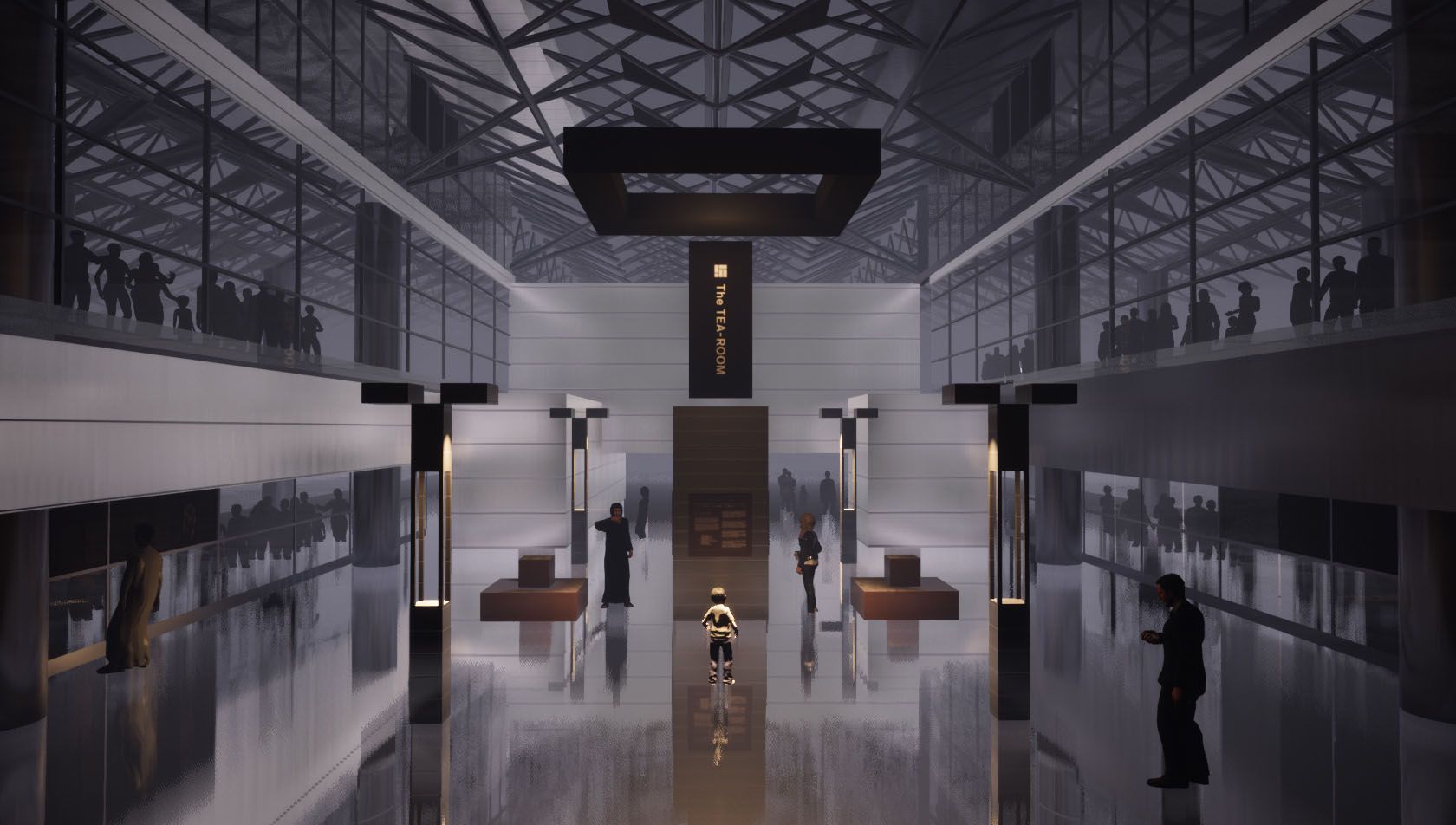
《VOID SYSTEM》 is an unrealised installation that sought to reconstruct this perceptual transformation through sound and artificial life, rather than reproducing the physical form of a tea room. It was conceived for Chubu Centrair International Airport, where mechanical noise, announcements, voices, and footsteps constantly intersect. The work did not seek to create silence by blocking out the surrounding sound. Instead, it proposed a “tea room of sound” within the noise of the airport by adding further layers of sound.
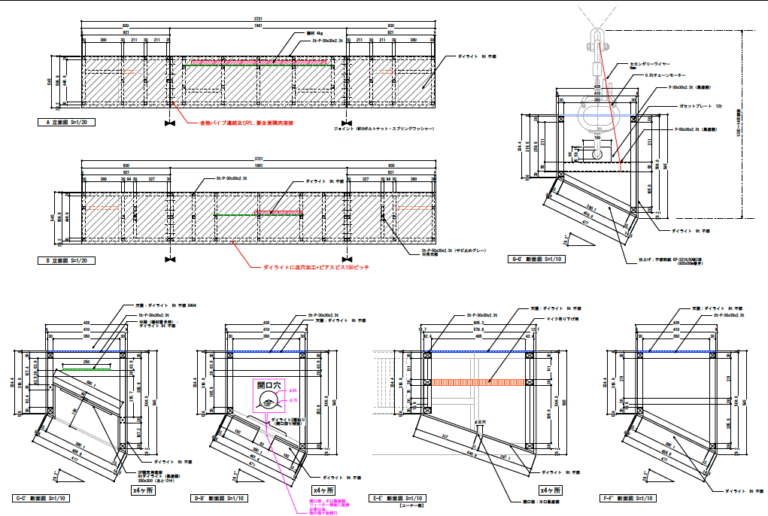
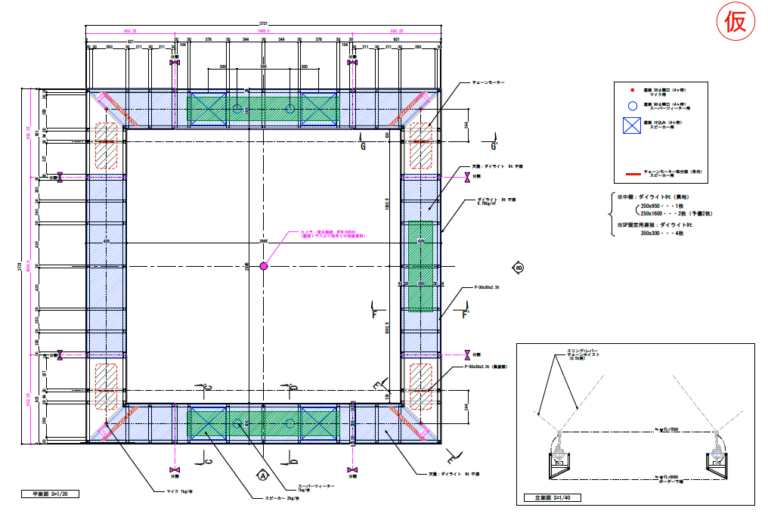
A minimal structure of aluminium truss and washi paper was designed to surround an acoustic field corresponding to the traditional four-and-a-half-tatami scale of a tea room. Highly directional and hypersonic speakers would concentrate sounds both within and beyond the audible range towards this area. Because sound inevitably reflects from the architecture and leaks beyond the intended perimeter, the field could never be completely enclosed. Its ritual boundary would be formed not by walls dividing inside from outside, but by a gradient of acoustic density. By crossing this gradient, a listener would remain physically within the airport while entering a different auditory world.
The sound was not conceived as a fixed composition. Artificial-life algorithms generated short fluctuations and longer transitions across multiple temporal scales. Like seasonal change or living processes, the acoustic environment would continue to evolve rather than repeat a single stable state. The work sought to produce stillness not by removing ambient sound, but by adding generated sound and continually transforming the relationships among its layers.
The “VOID” in the title refers both to an acoustic and spatial void and to the Buddhist concept of kū—śūnyatā, or emptiness. Emptiness is not simple nothingness. It describes how things possess no fixed, independent essence, but arise through conditions and relationships. The acoustic space of 《VOID SYSTEM》 likewise has neither an absolute boundary nor a fixed composition. Speakers, architecture, reflection and leakage, the generative system, and the listener’s body would together bring the space into being anew each time.
The work was scheduled to open at the airport’s Center Pier Garden in March 2020 as part of the Japan Media Arts Distributed Museum, a programme of Japan’s Agency for Cultural Affairs. After nearly a year of development, the artificial-life generation system and acoustic system had been completed and tested. However, the exhibition was cancelled two days before on-site installation was due to begin because of the spread of COVID-19. The surviving images are therefore not documentation of a completed installation, but renderings and technical drawings of a space designed up to the threshold of realisation.
At the same moment, human movement came to a halt, and airports and cities fell into a stillness no one had chosen. This did not mean that the work had been realised in another form. 《VOID SYSTEM》 imagined a stillness that one would enter voluntarily by crossing a boundary; the pandemic imposed suspension from outside. The void that was to have been composed through sound instead left another void: the absence of the work itself.
To create stillness without erasing sound. To make a ritual boundary without building walls. To bring a space into being through relationships and change, without giving it a fixed form. In 《VOID SYSTEM》, a void is not a place where nothing exists. It is a system that acts upon perception, shifting it into another state.